

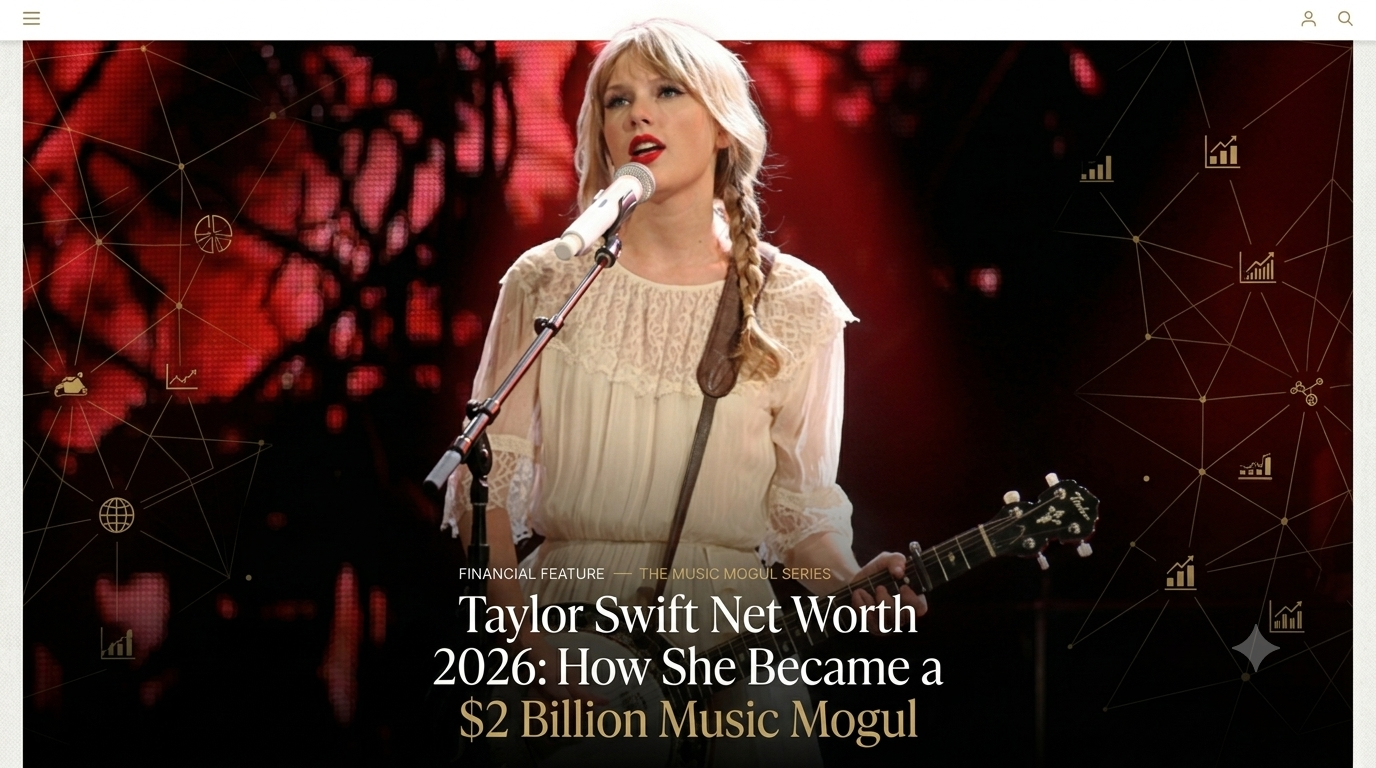
Taylor Swift Net Worth has officially crossed a fortune milestone few musicians ever reach. According to Forbes, Taylor Swift net worth climbed to an estimated $2 billion in 2026, cementing her status as the wealthiest female musician in history and one of the richest self-made women in the world. What makes her story remarkable isn’t just the size of the number — it’s how she got there. Unlike most entertainment billionaires, Swift didn’t build her fortune through a fashion line, a beauty brand, or a liquor label. She built it almost entirely on music: songwriting, touring, and — most importantly — ownership.
This article breaks down exactly how Taylor Swift Net worth became a $2 billion music mogul, from her early career and record deals to the Eras Tour, the fight over her masters, and the real estate and business ventures that round out her portfolio.
Taylor Swift’s Net Worth at a Glance
Different outlets calculate celebrity Taylor Swift net worth using different methods, so estimates vary slightly. Here’s where the major trackers land in 2026:
- Forbes: $2 billion (as of March 2026)
- Celebrity Net Worth: $1.8 billion
- Finance Monthly: approximately $2.05 billion
- Bloomberg (2025 estimate): $2.1 billion
Regardless of the exact figure, every major source agrees on the same headline:Taylor Swift net worth now well over $1.5 billion, and most place her at or near the $2 billion mark. That’s a staggering jump from the $500 million she was reportedly worth before the Eras Tour began in 2023.
Taylor Swift Net Worth From Billionaire to Double Billionaire: A Timeline
Swift’s rise to billionaire status happened faster than almost any musician in history, and her wealth has continued to accelerate since.
October 2023 — Forbes first identified Swift as a billionaire, with her fortune driven largely by early Eras Tour earnings and the value of her growing music catalog.
May 2024 — Celebrity Taylor Swift Net Worth’s more conservative tracking confirmed her billionaire status once the European leg of the Eras Tour wrapped and its profits were fully realized.
May 2025 — Swift announced she had reacquired the master recordings to her first six albums, a deal reported to be worth roughly $360 million, buying them back from the private equity firm that had owned them.
March 2026 — Forbes reported that Taylor Swift net worth had effectively doubled to $2 billion, fueled by the completed Eras Tour, new album releases, and continued royalty income from her now fully-owned catalog.
That trajectory — from $500 million to $2 billion in under three years — is almost unheard of in the entertainment industry, and it’s why financial analysts increasingly study Swift’s business strategy as a case study in artist-driven wealth building. Most celebrity fortunes grow gradually through a mix of endorsements, licensing, and steady career earnings. Swift’s growth curve looks different: it’s marked by a small number of very large, deliberate moves — the tour, the re-recordings, the masters buyback — each of which compounded on the last rather than functioning as isolated paydays.
It’s also Taylor Swift Net worth noting how unusual it is for any of this wealth to be “self-made” in the truest sense. Swift didn’t inherit a business empire or take over a family company. She started as a teenage singer-songwriter signed to an independent label in Nashville, and the assets that now make up the bulk of her fortune — her songs, her performances, her catalog — are, quite literally, things she created herself.
The Eras Tour: The Financial Engine Behind Her Fortune
No single project did more for Taylor Swift’s net worth than the Eras Tour. Running from March 2023 through December 2024, the tour became the highest-grossing concert tour in music history, with total revenue estimated at more than $2.2 billion.
A few numbers help put the scale of the tour into perspective:
- The tour grossed over $2 billion in ticket sales alone.
- Merchandise sales added roughly $400 million in additional revenue.
- The accompanying concert film, “Taylor Swift: The Eras Tour,” brought in an estimated $262 million.
- Swift is reported to have personally earned between $10 million and $13 million per show, according to Forbes estimates.
- After taxes, production costs, and fees, Swift is estimated to have retained around $190 million in post-tax personal earnings directly from the tour, with some estimates of her total retained wealth gain from the tour reaching closer to $460 million once catalog and streaming effects are included.
The Eras Tour didn’t just generate direct income — it created ripple effects across Swift’s entire business. Ticket demand was so overwhelming that it prompted a U.S. congressional inquiry into Ticketmaster’s dominance over concert sales. Streaming numbers for her back catalog spiked throughout the tour, merchandise sales soared, and the visibility of the tour significantly boosted the value of both her music catalog and her personal brand.
Music Catalog Ownership: The Real Wealth Driver
If the Eras Tour was the engine, Swift’s decision to own her music is the chassis that made long-term wealth possible. This is the piece of her story that separates her from almost every other musician in history.
Losing Her Masters
Swift’s original masters — the master recordings for her first six studio albums — were sold without her direct consent when Big Machine Records, her original label, was acquired by a talent management company in 2019. The masters were later sold again to a private equity firm. Swift was public about her frustration over losing control of her own recordings.
The Re-Recording Strategy
Rather than accept the loss, Swift began re-recording her first six albums starting in 2021, releasing them as “Taylor’s Version” projects. This strategy did two things: it gave her own recordings for fans and licensors to use instead of the originals, and it dramatically reduced the commercial value of the masters she didn’t own — putting pressure on the eventual sale price.
Buying Back Her Masters
In May 2025, that strategy paid off. Swift announced she had purchased the original masters to her first six albums outright, reportedly paying around $360 million. Combined with the recordings she already owned outright from every album released after leaving Big Machine, Swift now controls her entire body of work.
This matters enormously for Taylor Swift net worth because master recordings and publishing rights are appreciating assets. Every stream, sync license, commercial use, and re-release now sends royalty income directly to Swift instead of to a third party. Estimates place the value of her overall music catalog — including masters, publishing, and Taylor’s Version recordings — at somewhere between $600 million and $900 million on its own.
Taylor Swift Album Sales and Streaming Records
Swift’s catalog isn’t just valuable because she owns it — it’s valuable because it consistently sells and streams at a scale few artists ever achieve.
Some standout numbers from her album sales history:
- Her debut album sold roughly 40,000 copies in its first week — modest by later standards, but the start of a steep upward trend.
- “1989” sold 1.287 million copies in its first week; the re-recorded “1989 (Taylor’s Version)” actually outsold the original, moving 1.359 million copies in its first week and accounting for a reported 43.8% of all album sales in the U.S. that week.
- “Reputation” sold 1.24 million units in its first week.
- “evermore” reached 1 million units in combined sales and streaming equivalents in its debut week.
More recently, Swift’s 2026 single “Opalite,” from her album “The Life of a Showgirl,” became her fourteenth number-one hit on the Billboard Hot 100, and her 1989 album became her first to reach 550 weeks on the Billboard 200 chart. These aren’t just chart trivia — sustained commercial dominance over more than a decade is exactly what keeps royalty and licensing income flowing at a high level year after year.
Real Estate: A Growing Physical Portfolio
Beyond music, Swift has assembled a real estate portfolio worth an estimated $110 million or more, spread across several U.S. states.
Her properties reportedly include homes in Nashville, New York City, Los Angeles, and Rhode Island. One notable example is a Rhode Island beachfront estate that has become a recurring backdrop for her personal life and social gatherings. She also previously owned a home in Hyannisport, Massachusetts, near the Kennedy family compound, which she purchased for $4.9 million in 2012 and later sold for $5.675 million just a few months later — an early example of her instinct for making profitable property moves even outside of music.
Real estate isn’t the largest piece of Swift’s fortune, but it functions as a stable, appreciating asset base that diversifies her wealth beyond the entertainment industry.
How Taylor Swift Compares to Other Music and Entertainment Wealth
Swift’s $2 billion valuation puts her in rarefied territory, not just among musicians but among self-made women generally. She currently ranks among the top self-made women on Forbes’ wealth lists, and by most measures she is now significantly wealthier than most of her peers in the music industry.
For comparison, based on recent estimates:
- Beyoncé: estimated net worth of $700–780 million
- Ariana Grande: estimated net worth of roughly $250 million
- Miley Cyrus: estimated net worth of roughly $160 million
- Justin Bieber: estimated net worth of roughly $200 million, following the sale of his song catalog
What sets Swift apart isn’t simply that she earns more — plenty of top musicians earn tens of millions annually. It’s that she has converted those earnings into owned, appreciating assets: her masters, her publishing, her real estate, and reinvested capital, rather than letting the bulk of her income pass through to labels, managers, or licensing companies.
Beyond the Catalog: Other Income Streams
While touring and catalog ownership form the backbone of Taylor Swift’s fortune, several smaller — but still significant — income streams add to the total picture.
Film and streaming income. The Eras Tour concert film wasn’t just a marketing tool; it was a genuine box office success, bringing in an estimated $262 million and demonstrating that Swift’s audience will show up for more than just live shows and album drops. She has also contributed original music to film soundtracks, including a 2026 song written for “Toy Story 5,” extending her income streams into licensing and sync deals outside her own catalog.
Merchandise. Merchandise tied to the Eras Tour alone is estimated to have generated around $400 million, and Swift’s merchandise operation — spanning vinyl variants, apparel, and tour-specific collectibles — has become a meaningful revenue category on its own, separate from ticket sales.
Brand partnerships and endorsements. Unlike some of her peers, Swift has historically been selective about traditional celebrity endorsement deals, preferring to concentrate her public-facing business activity around her own music, tours, and merchandise rather than licensing her image to outside brands. This selectivity is itself a business strategy — by not oversaturating her brand with unrelated products, she preserves the commercial power of her name for her own projects, where she captures the full economic upside rather than a licensing fee.
Cash and investments. Financial trackers estimate that Swift holds a substantial cash and investment position — funds not tied up in real estate or the music catalog — that continues to grow through interest, investment returns, and retained earnings from her touring and royalty income. This liquid portion of her fortune provides flexibility for future acquisitions, whether that means more real estate, further catalog investments, or new business ventures.
The Business Mind Behind the Music
Part of what makes Swift’s financial rise notable is that it isn’t accidental. She has been candid about growing up around financial literacy — her father, Scott Swift, worked as a stockbroker and wealth manager, and her mother, Andrea, worked in mutual fund sales before Taylor’s career took off. That background appears to show up in how she’s run her business as an adult.
Swift operates through her own management company, where she serves as an active decision-maker rather than a passive client of a larger industry machine. Her decision to re-record her albums rather than simply accept the loss of her masters is frequently cited by industry analysts as a uniquely aggressive and successful use of leverage — she effectively used her own fanbase and market power to make the assets she didn’t own less valuable to their new holders, then bought them back on her own terms.
That approach has also had an industry-wide ripple effect: several other artists have pointed to Swift’s re-recording strategy as inspiration for pushing harder to retain or reclaim ownership of their own work. In many ways, Swift changed the default conversation in the music industry — ownership of masters and publishing, once treated as a back-office detail negotiated away early in an artist’s career, is now something younger artists and their teams negotiate for aggressively from the start of a record deal.
Swift has also shown discipline in how she scales her business without over-extending into unrelated ventures. Rather than launching a beauty line, a spirits brand, or a fashion label — the traditional playbook for celebrities looking to diversify income — she has kept her business activity tightly connected to her core strength: songwriting and live performance. That focus has arguably made her fortune more durable, since it isn’t dependent on the success of ventures outside her direct expertise or public trust.
What’s Next for Taylor Swift’s Net Worth?
With her masters fully owned, a completed record-breaking tour, and a steady stream of new music — including recent chart-topping singles and soundtrack contributions like her 2026 song for “Toy Story 5” — Swift’s income streams show no signs of slowing down. Industry analysts have suggested that if she continues touring and her catalog continues appreciating in value, her fortune could climb well past the $2 billion mark in the next few years.
Because so much of her wealth is now built on assets she owns outright — rather than one-time earnings — her net worth is less dependent on any single tour or album than it once was. Streaming royalties, licensing deals, publishing income, and the long-term value of a catalog that has already proven it can dominate charts more than a decade after her debut all continue to compound in the background.
Frequently Asked Questions
Is Taylor Swift a billionaire?
Yes. Forbes first confirmed Swift’s billionaire status in October 2023, and her fortune has continued to grow since, reaching an estimated $2 billion by March 2026.
How did Taylor Swift Net Worth become so wealthy?
Her wealth comes primarily from three sources: the record-breaking Eras Tour, ownership of her music catalog (including masters and publishing after buying back her original recordings in 2025), and a real estate portfolio worth an estimated $110 million.
Does Taylor Swift own her masters now?
Yes. As of May 2025, Swift owns the masters to all of her studio albums — the recordings from her time after leaving Big Machine Records were already hers outright, and she purchased the masters to her first six albums for a reported $360 million.
How much did the Eras Tour earn?
The Eras Tour grossed more than $2.2 billion in total revenue, including ticket sales, merchandise, and the accompanying concert film, making it the highest-grossing concert tour in history.
Is Taylor Swift Net Worth richer than Beyoncé?
Yes, by most current estimates. Taylor Swift net worth of roughly $2 billion significantly exceeds Beyoncé’s estimated net worth of $700–780 million.
