

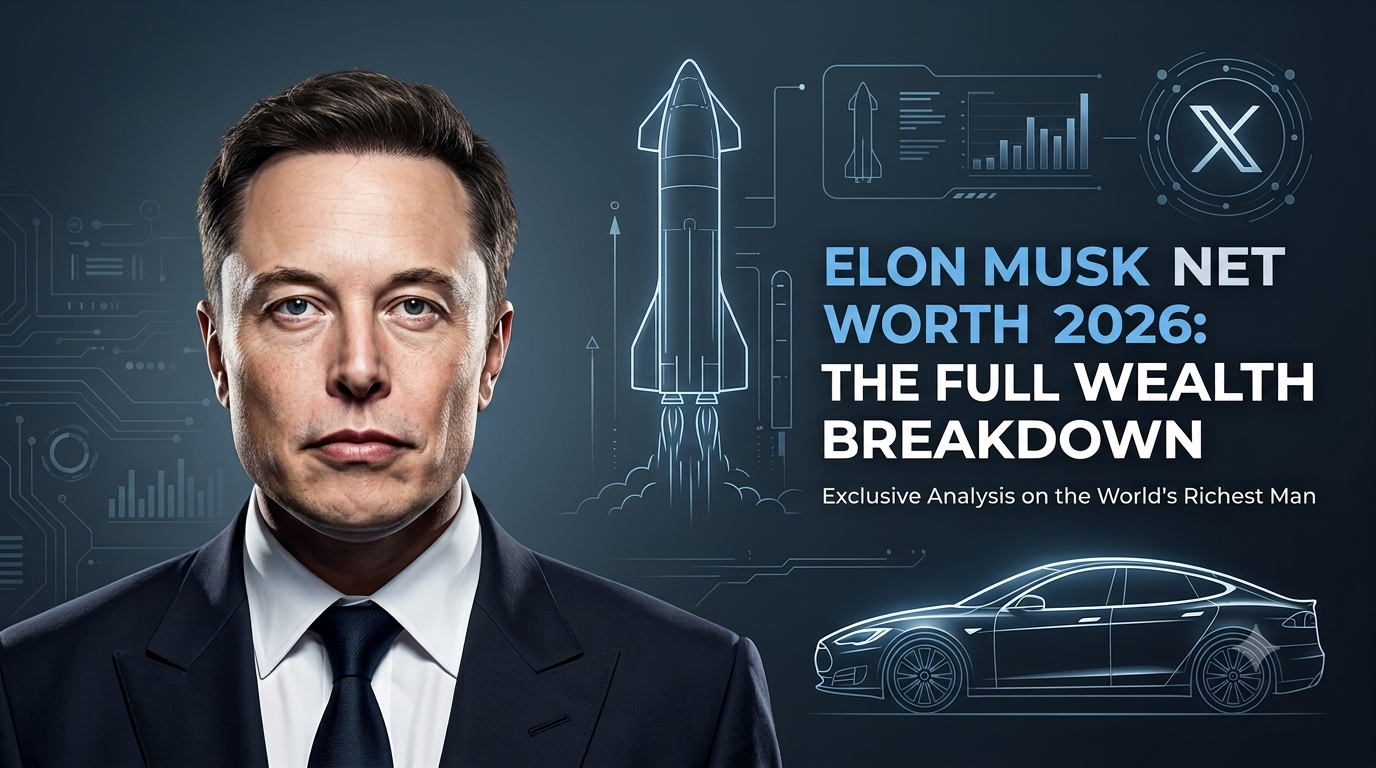
Elon Musk made history in 2026. On June 12, when SpaceX completed its long-awaited initial public offering, Musk became the first person ever to be Elon Musk Net Worth more than $1 trillion. It was a milestone decades in the making — one that started with a $180 million payout from the sale of PayPal in 2002 and ended with a fortune larger than the GDP of most countries on Earth.
But Musk’s wealth has never been simple, and 2026 has been no exception. Just weeks after crossing the trillion-dollar line, a slide in SpaceX’s share price briefly knocked him back below it. His net worth swings by tens of billions of dollars in a single trading session, driven almost entirely by the value of his stakes in a handful of companies he founded or leads.
This article breaks down exactly how much Elon Musk net worth is in 2026, where that wealth comes from, how it has changed over the year, and what could move it next.
Elon Musk’s Net Worth at a Glance (2026)
As of mid-2026, estimates of Musk’s net worth vary by source and methodology, but they cluster in a similar range:
- Bloomberg Billionaires Index: roughly $1.01–1.23 trillion
- Forbes Real-Time Billionaires: roughly $1.1–1.2 trillion
- Peak 2026 estimate: as high as $1.4 trillion in mid-June, according to some trackers
The gap between these numbers comes down to how each outlet values Musk’s private and newly public holdings, particularly SpaceX, xAI, and The Boring Company. Because so much of his fortune sits in company stock rather than cash, small differences in valuation assumptions can translate into tens of billions of dollars of difference in the final figure.
It’s also worth noting that Elon Musk net worth is not the same as liquid wealth. More than 95% of Musk’s fortune is held in equity, and a significant portion of his SpaceX shares are subject to post-IPO lockup restrictions, meaning he cannot simply sell them for cash even if he wanted to.
The SpaceX IPO: The Event That Made Musk a Trillionaire
The single biggest driver of Musk’s 2026 wealth surge was the SpaceX initial public offering.
For years, SpaceX operated as a private company, with its valuation set periodically through funding rounds and employee tender offers. That changed in February 2026, when SpaceX absorbed xAI, Musk’s artificial intelligence venture, in an all-stock merger that valued the combined company at roughly $1.25 trillion.
Then, on June 12, 2026, SpaceX began trading publicly on the Nasdaq under the ticker SPCX. The offering priced at $135 per share, implying a valuation near $1.77 trillion, and raised approximately $75 billion — making it the largest IPO in history, more than double the size of Saudi Aramco’s 2019 listing. On its first day of trading, the company’s valuation pushed past $2 trillion.
Musk’s stake in SpaceX, estimated at around 38–42%, was suddenly worth more than $760 billion on paper. That single event is responsible for the majority of his jump from roughly $800 billion in early 2026 to well over $1 trillion by mid-year.
Importantly, the IPO converted a private valuation into a public, tradeable one — but it did not hand Musk hundreds of billions of dollars in cash. Newly public founders are typically restricted from selling shares for 90 to 180 days after listing, and Musk’s holdings carry additional control provisions that limit how quickly he could liquidate even if the lockup expired.
Breaking Down the Fortune: Where Musk’s Wealth Actually Comes From
SpaceX: The Dominant Asset
SpaceX is now, by far, the largest single component of Musk’s net worth. Once purely a rocket and satellite-internet company, SpaceX has evolved into a diversified technology conglomerate:
- Starlink, its satellite broadband division, has become a major independent revenue source and a global telecommunications provider
- NASA contracts remain a steady, high-value revenue stream for crewed and cargo missions
- xAI, absorbed into SpaceX in February 2026, added artificial intelligence development to the company’s portfolio
With Musk’s stake worth several hundred billion dollars, SpaceX alone accounts for well over half of his total fortune.
Tesla: Still Substantial, No Longer Dominant
Tesla was once the primary engine of Musk’s wealth. It remains significant — roughly a quarter of his total net worth — but it’s no longer the main story.
Musk owns approximately 11–13% of Tesla directly. On top of that, he holds unvested options from his controversial 2018 CEO performance package: 304 million options at a $23.33 strike price. That package had a long legal battle behind it — a Delaware judge voided it in January 2024, shareholders re-ratified it later that year, and the Delaware Supreme Court ultimately restored it in December 2025. Musk exercised those options in June 2026.
Combined, Musk’s direct Tesla shares and option holdings put his total Tesla-linked exposure at somewhere in the neighborhood of $170–280 billion, depending on the stock price on any given day.
Notably, Musk draws no salary from Tesla. Under his compensation arrangement, he is paid entirely through stock awards tied to the company hitting specific valuation and operational milestones — an approach the Tesla board has used since 2018.
xAI and X (formerly Twitter)
Musk’s AI company, xAI, was folded into SpaceX in the February 2026 merger, so it no longer exists as a separate line item in his net worth — its value is now baked into the SpaceX figure.
X, the social media platform Musk acquired in 2022, was merged into xAI roughly a year before that xAI-SpaceX deal. As a result, X’s value is also now indirectly represented within Musk’s SpaceX stake rather than counted on its own. Prior to that consolidation, X’s standalone value had been estimated in the $15–20 billion range, a fraction of Musk’s overall wealth and reflective of the platform’s rocky post-acquisition performance.
The Boring Company and Neuralink
Musk holds smaller stakes in two other ventures:
- The Boring Company, his tunneling and infrastructure startup
- Neuralink, his brain-computer interface company
Both are privately held and contribute a comparatively minor amount to his overall fortune, though both carry long-term speculative upside if their technologies scale.
Elon Musk’s Wealth Timeline: From $2 Billion to $1 Trillion+
Musk’s rise to the top of the world’s wealth rankings didn’t happen overnight. Here’s a condensed look at the key milestones:
- 2002: Made $180 million when PayPal was sold to eBay
- 2012: First appeared on the Forbes billionaires list, with a net worth of $2 billion
- Start of 2020: Net worth around $27 billion
- End of 2020: Net worth jumped to roughly $150 billion, driven by Tesla’s stock surge
- 2021: Net worth reached approximately $300 billion
- December 2024: Crossed $400 billion
- February 2026: SpaceX-xAI merger pushes his wealth toward $850 billion
- June 12, 2026: SpaceX IPO makes him the world’s first trillionaire, with a net worth around $1.1–1.2 trillion
- Mid-June 2026: Wealth peaks near $1.3–1.4 trillion in some estimates
- July 1, 2026: A slide in SpaceX shares briefly cuts his fortune by more than $50 billion, temporarily dropping him below trillionaire status
This trajectory illustrates just how volatile concentrated, stock-based wealth can be. A single company’s share-price movement can add or subtract tens of billions of dollars from Musk’s net worth in a matter of hours.
Why Musk’s Net Worth Swings So Dramatically
Unlike many billionaires who diversify into real estate, bonds, or index funds, Musk has kept the overwhelming majority of his wealth concentrated in the companies he founded and runs. This strategy has paid off enormously — but it also means his fortune is unusually exposed to volatility.
A few factors explain the swings:
- Concentration risk. With over 95% of his wealth in equity — mostly in two companies — Musk’s net worth moves in near lockstep with SpaceX and Tesla share prices.
- Newly public stock. SPCX has only been trading since June 2026, and newly listed stocks tend to be more volatile than established ones as the market works out a stable valuation.
- Regulatory and legal exposure. Ongoing SEC scrutiny of Tesla disclosures, questions around content moderation on X, and the long tail of Musk’s political involvement all create scenarios where a single adverse development could shift investor sentiment quickly.
- Leverage. Like many ultra-wealthy individuals, Musk has used shares as collateral for loans rather than selling them outright, a strategy that avoids triggering capital gains taxes but adds another layer of sensitivity to stock-price movements.
How Musk’s Wealth Compares Globally
To put Musk’s fortune in perspective:
- At his June 2026 peak, Musk was worth nearly four times as much as the world’s second-richest person, Larry Page.
- His wealth briefly represented roughly 3% of total U.S. GDP — a concentration of individual wealth not seen since John D. Rockefeller, whose 1913 fortune represented about 2.3% of GDP at the time.
- According to analysis referencing Oxfam data, Musk’s peak 2026 net worth exceeded the combined wealth of Warren Buffett, Bill Gates, and Jeff Bezos, and surpassed the total wealth held by the poorest 46% of the global population — an estimated 3.8 billion people.
These comparisons have fueled renewed political debate. Figures such as Senator Elizabeth Warren and other progressive lawmakers pointed to Musk’s trillionaire status as fresh justification for wealth tax proposals, arguing that such extreme concentration of wealth raises questions about economic fairness and influence.
Taxes and Philanthropy
Musk’s approach to both taxes and charitable giving has drawn scrutiny over the years.
On taxes, ProPublica has reported that Musk paid no federal income tax in 2018, a year in which his wealth grew enormously but his taxable income did not, since most of his net worth exists as unrealized stock gains rather than cash income. Between 2014 and 2018, Musk paid approximately $455 million in taxes on about $1.52 billion of reported income. Following a large Tesla stock sale in 2021, his estimated tax bill for that year alone was around $12 billion.
On philanthropy, biographer Walter Isaacson has noted that Musk has historically shown limited interest in traditional charitable giving. Musk has said he believes he can do more good for humanity by reinvesting his wealth into ventures like renewable energy, space exploration, and AI safety than by directing it toward conventional philanthropy. He does direct some giving through the Musk Foundation, a charitable foundation he funds and controls, though his overall philanthropic footprint remains modest relative to his fortune compared to other billionaires.
What Could Move Elon Musk Net Worth Next
Several factors are likely to shape where Musk’s wealth heads for the remainder of 2026 and beyond:
- SpaceX’s post-IPO stock performance. As a newly public company, SPCX’s valuation will likely continue to be volatile as the market digests its true worth, quarterly earnings, and Starlink’s growth trajectory.
- Tesla’s recovery. Tesla shares fell as low as roughly $353 in April 2026 before climbing back toward record territory later in the year — a recovery that has meaningfully added back to Musk’s Tesla-linked wealth.
- Lockup expiration. Once SpaceX’s IPO lockup period ends, any decision by Musk to sell shares could affect both his liquidity and the stock price itself.
- Regulatory developments. Ongoing SEC scrutiny, European content regulations affecting X, and any new legal challenges could introduce fresh volatility.
- Broader economic conditions. As with any large equity holder, macroeconomic shifts — interest rates, market sentiment toward growth and tech stocks, and geopolitical events — will continue to influence valuations across Musk’s holdings.
Most analysts caution that a large share of Musk’s 2026 wealth gain came from the one-time step-up created by the SpaceX IPO, rather than steady, ongoing appreciation. That suggests his rate of wealth growth is likely to flatten in the back half of the year compared to the dramatic jump seen in June.
Read More:Charlie Kirk Net Worth: How Much He Was Net Worth in 2026?
Conclusion
Elon Musk net worth 2026 tells the story of a fortune built almost entirely on concentrated bets in transformative technology — rockets, electric vehicles, and artificial intelligence — rather than diversified traditional investments. The SpaceX IPO in June 2026 was the defining event of his financial year, instantly converting a private valuation into public market reality and making him the first trillionaire in recorded history.
But as the events of just the following month demonstrated, that wealth is anything but static. A $50 billion swing in a single week is possible when nearly all of your fortune is tied to the daily performance of two or three companies. Whether Elon Musk net worth settles above or below the trillion-dollar mark by the end of 2026 will depend largely on how SpaceX’s newly public stock performs, how Tesla’s ongoing recovery holds up, and how regulatory and political pressures play out.
What’s clear is that Musk’s wealth — and the debates it fuels about taxation, inequality, and the power of concentrated fortunes — will remain one of the most closely watched storylines in business and economics for the rest of the year.
Frequently Asked Questions
How much is Elon Musk net worth right now in 2026?
Estimates place Elon Musk net worth in the range of roughly $1 trillion to $1.2 trillion as of mid-2026, though the exact figure fluctuates daily based on SpaceX and Tesla share prices. Bloomberg and Forbes sometimes differ by tens or hundreds of billions of dollars due to different valuation methodologies for his private and newly public holdings.
Is Elon Musk officially the world’s first trillionaire?
Yes. Musk became the first person in history to be confirmed at a net worth exceeding $1 trillion on June 12, 2026, following the SpaceX IPO. However, his wealth has since fluctuated below that threshold at times, including briefly on July 1, 2026, after a decline in SpaceX’s share price.
What is the main source of Elon Musk’s wealth?
The majority of Elon Musk net worth comes from his ownership stake in SpaceX, which he founded in 2002. His Tesla holdings, including direct shares and stock options from his 2018 compensation package, make up most of the remainder. Smaller stakes in The Boring Company and Neuralink contribute a relatively minor share.
Does Elon Musk get a salary from Tesla or SpaceX?
No. Musk does not draw a traditional salary from Tesla; his compensation is tied entirely to stock options that vest when the company hits specific valuation and performance milestones. His SpaceX wealth similarly comes from equity ownership rather than salary.
Why does Elon Musk net worth change so much day to day?
Because more than 95% of his wealth is held in company stock rather than cash, Elon Musk net worth is directly tied to the daily share-price movements of SpaceX and Tesla. This concentration means his fortune can rise or fall by tens of billions of dollars within a single trading session.
How much of Musk’s wealth is actual cash he can spend?
Very little, relative to his total net worth. Most of his fortune exists as unrealized equity in his companies. A significant portion of his SpaceX shares are also subject to post-IPO lockup restrictions that prevent him from selling for a set period after the offering. Like many billionaires, Musk has used shares as collateral for loans rather than selling stock outright.
Does Elon Musk pay taxes on his wealth?
Musk pays taxes on realized income and capital gains, but because most of Elon Musk net worth is unrealized stock value, his effective tax rate relative to his total wealth has been a subject of public debate. Reporting has shown he paid no federal income tax in at least one recent year, despite his net worth growing substantially during that period, because unrealized gains are not taxed as income under current U.S. law.
How does Elon Musk net worth compare to other billionaires?
At his 2026 peak, Musk’s fortune exceeded the combined net worth of Warren Buffett, Bill Gates, and Jeff Bezos, and he was worth roughly four times as much as the world’s second-richest person. His wealth has also been compared to the GDP of entire countries and to the combined wealth of billions of the world’s poorest people.
Will Elon Musk net worth keep growing?
It’s uncertain. Much of his 2026 wealth increase came from the one-time valuation jump created by the SpaceX IPO rather than steady growth, and analysts generally expect that pace to slow. Future changes will depend on SpaceX’s performance as a newly public company, Tesla’s ongoing recovery, and broader market and regulatory conditions.
What happens when Elon Musk’s SpaceX lockup period ends?
Once the post-IPO lockup expires, Musk will be able to sell SpaceX shares more freely, which could affect both his personal liquidity and the stock’s price if large sales occur. Until then, much of his SpaceX-linked wealth remains largely illiquid on paper.
